Showing posts with label teaching. Show all posts

Monday, December 23, 2013

Failure and Faith: My Exit From Teach For America

This song, a spoof created by a comedy group at my alma mater, has been thundering in my brain for the last few weeks. It isn't an appropriate theme for my exit from Teach For America and my short elementary teaching career, but the sentiment does accurately convey how I feel at times when reflecting on this experience. 

Ouch! Both physically and emotionally. 

Defining Failure

The online Oxford dictionary gives three different perspectives to the definition of the word fail:
  1. Be unsuccessful in achieving one’s goal
  2. Neglect to do something
  3. Break down; cease to work well
All three of these forms of failure of been present in my experience as a teacher. I have been unsuccessful in achieving my goals for academic ability of my students, I have neglected to take the required action to be prepared to be the teacher my students need in order to succeed, and I literally broke down -"cease to work well" does not even begin to approach the necessary description of my personal state of mind at the end of the semester. 

I am not having a pity party here, rather I am being very truthful. I failed. 

Yes, there are many contributing reasons to why this happened which are important and valid. However, regardless of what I cite or go back to, the fact that I've failed remains. I have failed myself, my students, the families of my students, my fellow teachers and administration, and in many degrees my own family. 

However, failure isn't synonymous with hopelessness, death, or a permanent road block. While harmful effects of my failure are and will be present, there are positive consequences. The video below illustrates an important concept I've learned about failure. 


I spent two years preparing for and dreaming about Teach For America, endured a grueling summer of training away from my pregnant wife, and then battled four months of work in the classroom and then . . . I quit. For what? While all that time, energy, excitement, money, and work that it took to go through this experience, I am grateful that I was able to learn with such finality that TFA and elementary teaching in general is not where I need to be right now. There is no question left in my mind. I took the wrong turn, and now I am going backwards a little and will soon find a more suitable path for my family and I.

Failure and Faith

Spiritually speaking, I am aware that often we are called to endure through challenging times and trials in order to be refined into worthy disciples of Christ. In listening to President Monson's most recent conference address I felt that perhaps I should just keep hashing out sub par lesson plans and hatch new management schemes that didn't work. Perhaps if I just kept enduring things would work out and I would find success.

However, it became clear that this was not the right mindset. For the sake of both my own students, and my own family I needed to leave.

A poorly stitched panorama of my students on my last day.
My wife Kassie and son Hinckley
I love my students very much, and wish with my whole being that I could be the teacher they need in order to advance to the next grade and get onto a path that will lead them towards self sufficiency in adulthood. I sobbed like a infant when I spoke to them about leaving. However, I can't be that teacher AND the father and husband I want to be to these two lovely folks at this present time. I don't have the experience, mental strength, or physical energy to do both. 

So the natural question resulting from the decision was something like, "well if I quit then what am I going to do?" and that is where the leap of faith came in. I did't have an answer, and neither did Kassie. The scripture from the Book of Mormon story of Nephi returning to Jerusalem came frequently to my mind, "And I was led by the Spirit, not knowing beforehand the things which I should do." Paul wrote to the Hebrews, "Now faith is the substance of things hoped for, the evidence of things not seen." We definitely felt a new understanding to Elder Packer's constant analogy of taking a step into the dark and hoping for the light to come on. And then it did. 

Almost a week after reaching the decision to leave teaching, I landed a job that offered everything and more that I could have hoped for at this time. I will be using skills from my undergraduate experience at BYU, and will have time to spend with my family. Even better, my very supportive principal found a replacement teacher who is very experienced and ready to enter my classroom in January. I can say that every friend and co-worker has been extraordinarily kind and thoughtful during this process. I am indeed grateful that the pain of failing here had not been made worse through comments and actions of others. While it has been very hard to leave my classroom, I know it is the right thing for my family. 

Failure Is Normal

There were and still are many feelings that accompanied me home as I drove away from school for the last time; Shame, joy, guilt, hope, anger, and even peace. There are many unresolved questions such as: What will happen to my students? What could I have done differently to avoid this? Would I do this again? Is Teach For America deserving of blame or is it my fault 100%? Does it matter? 

Regardless of the answer to these questions above and the many others that continue to swirl around me, it is clear that failing is a regular part of mortality. As I watched my son experience his regular and somewhat painful "tummy time" this morning I thought about how we never laugh or mock babies for failing to walk by a certain date, or for being able to speak correctly. He is doing his best to push against gravity and develop into a full-functioning human being. If you can get past the obnoxious and pathetic sounds of his crying, the scene is actually both very inspiring and instructional. I too am doing my best, and though these past months I have resembled my whining son in more ways than one, I recognize that I am a better person and more prepared to serve God and my fellow man in a capacity that is more aligned to my skill set and personality. 


Wednesday, November 20, 2013

Psychic Entropy and Educational Pornography


In his seminal book, Flow, Mihaly Csikszentmihalyi explains the state of mind called psychic entropy by relating a story of a assembly line worker who ends up in a very frustrating and extreme position. This particular worker had a tire on his car that was low on air and he didn't have the money to replace it. He continued to fill it up in the morning before work and in the evening when he drove home as he anticipated his next income check. He finally lost control of things at work and snapped at the other employees. "All through the day he worried: 'Will I make it home tonight? How will I get to work tomorrow morning?' These questions kept intruding in his mind, disrupting concentration on his work and throwing a pall on his moods."

This man, Csikszentmihalyi continues, "is a good example of what happens when the internal order of the self is disrupted. The basic pattern is always the same: some information that conflicts with an individual's goals appears in consciousness. Depending on how central that goal is to the self and on how severe the threat to it is, some amount of attention will have to be mobilized to eliminate the danger, leaving less attention free to deal with other matters . . . prolonged experience of this kind can weaken the self to the point that it is no longer able to invest attention and pursue its goals"(p.37).

After reading this a few days ago, I experienced a short-lived moment of euphoria that someone had actually put into writing the exact feeling I have been experiencing for the last four months. I have always struggled to make decisions, especially when it comes to whether my choices directly could effect the feelings and opinions of others. As a new father (and fairly recently married man), a new professional, a recent graduate, and a new citizen of Oklahoma I am only now realizing the full impact of balancing all these roles and expectations. The result is near complete paralysis.

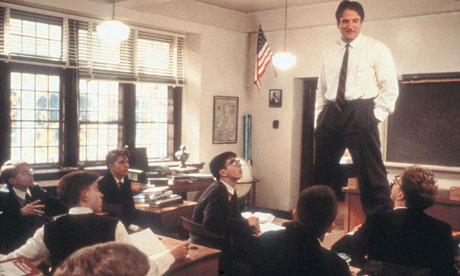
Perhaps one of the biggest contributors to my feelings of psychic entropy is my own unrealistic perception of what successful teaching looks like. Until recently I think that deep down I thought I could be that teacher who jumps on the desk and yells Carpe Diem! and captures the imagination of my young and eager students on a daily - no hourly - basis. In short, until this point it is likely I have been under the influence of educational pornography.


In a short and illuminating post by +Bryce Bunting the idea of educational pornography is explained more fully. Films like Stand and Deliver, or Freedom Writers often captivate and inspire audiences, but don't necessarily paint a realistic idea of what teachers can and should be doing in the classroom.
The reality is that very few teachers have the time, energy, or disposition to approach teaching in the super-human way that is subtly advocated for in these kinds of films. And, when teachers are made to feel that they should all be like Ron Clark (one of the new breed of "inspiring," "innovative," and superstar educators), frustration, hopelessness, and feelings of failure won't be far behind.
Don't get me wrong, the Ron Clarks of the world aren't imaginary. They are real and they are wonderful. However, it is clear that living a balanced and healthy life while maintaining this super teacher lifestyle is simply not sustainable for me or most people in general. 

So I will continue on my way, doing my best. What more can I do, then give my all within the boundaries my mental, physical, and spiritual health will allow? I hope to overcome my sense of psychic entropy and begin making some steps forward. 

"So much in life depends on our attitude. The way we choose to see things and respond to others makes all the difference. To do the best we can and then to choose to be happy about our circumstances, whatever they may be, can bring peace and contentment." 


Sunday, November 3, 2013

3. Self Control is the Gateway to Service

Looking back on my 6 "lessons" learned in the first 3 weeks of teaching, I am surprised to find that they still ring true to me. I wonder if this will be the case by the end of the year? I have now been in the classroom for over two months (it feels like much longer) and point number 3 feels more true than ever.

Found this on Reddit. 

Self control is an attribute our society at large struggles with. Instant gratification, 24/7 access to whatever whimsical or serious need we think up, and the false sense of value placed on "being busy" are just a few things I see as contributing to the degrading of this important characteristic.

Beyond our drive-thru and on-demand culture, self control manifests itself in education in a way I had not anticipated. When I started at my school, many teachers and the Principal told me, "Never let them see you sweat." In other words, don't let the students know that they are getting to you.

Well that did't work out so well.

Never in my life have I struggled more to control my words, the level of my voice, and the negative flood of emotions that inundate room 27 each day. Not to mention managing the frustration with things outside the classroom such as impossible insurance rates for teachers, apartment problems, and a seemingly never-ending workload that appears to have assassinated personal and family time.

Many days I keep my own tally of happy and sad points on the whiteboard, just to help me better manage my own person, and maybe help the students (who are 7-8 years old) begin to understand that everyone, young and old, must learn to manage their feelings.

:( = moments I lost control and went crazy
:) = moments I managed the chaos of my own feelings
The result of my two month wrestle with such feelings of anger and inadequacy have not rendered me as a new hero or refined instructor. At least not yet. 

But I do know that in order to actually help my students and my family, I first need to be able to control and help myself. Thus self control is the gateway to service. It is so easy to say, but very difficult to do. 

How can we help the hungry if we spend excess on food ourselves? How do we thoughtfully serve others if we are too busy being worried and depressed about our own shortcomings? 

The US Air Force mantra of "Service Before Self" is a companion of the concept I am addressing here. In order to serve others before ourselves, we must have mastery over our own passions, desires, and emotions. We must manage our own person, and then actively choose to lift others before putting our own ambitions forward. 

Sunday, October 6, 2013

1. There is so much more to public school than academics

As referred to in my last post, I am beginning to learn a lot in my classroom. The first point is that there is much more involved in public education than most people seem to realize.

Something I saw on Facebook and felt an affinity with. 

First, just plain academics without social context, vision, or sense of community among students is hallow. Teaching with only a focus on pure numbers and reading is like a military leader or football coach teaching the necessary tactics of their respective professions but leaving out any mention of things like "band of brothers", team, community, trust, and respect.

Admittedly, I realized this need for student trust and safety before I started teaching. What I did't include in my perspective was the fact that some students may resist any move towards working with others or controlling their words and actions. It is very difficult to figure out what these students need and what challenges they are facing both in and out of the classroom.

Now when I am focusing on academics and actually teaching material, it isn't just presenting information. No, even this must be done in a way that builds the social and moral identity of the student. The spider man cheer, the watermelon cheer, silent cheers, love fingers, 2 claps on 2, and other things are used at an insane pace and frequency to keep students engaged and feeling positive. Students also deal with a large quantity of frustration when doing their work, and coping with these feelings of inadequacy usually isn't something all students have learned about. They may choose to throw their desk, cuss out their neighbor, jump out of their seat and steal someone's pencil, or just cry and scream. Teaching them a better way, while also actually teaching them content is a challenge I really don't understand quite yet.


Saturday, September 14, 2013

3 Weeks in the Trenches


Woah. I'm here.

Originally the title of this blog was "1 week in the trenches" . . . but obviously I didn't get around to publishing till now. Teaching at an elementary school in an area riddled with poverty is not easy. Of course it is not easy. The reason I signed up through Teach For America was to get into a classroom and see first hand what was happening in struggling public schools. I have done a little writing and thinking about education and "reform" and all that, but I've always known I could never understand or make a meaningful difference in the field of education if I didn't get into the trenches at least for a while. I wanted a first hand experience.

And now I am getting it.

So far, six lessons have been injected into me through my short experience as a 2nd grade teacher thus far:
1. There is so much more to public school than academics
2. Teachers actually are superhuman
3. Self control is the gateway to service
4. Teaching is about finding the sweet and tender balance amidst insane chaos
5. Educational technology is cool, but is it possible the field is turning a blind eye to the biggest issues?
6. Continued raw failure is the essential attribute of true learning
  
If you are a current teacher, or have taught before, you may be holding back a knowing smile. I'm sure I sound like a really silly kid who thinks he has figured it all out. While it is true I am a rather silly idealistic kid, it has never been more clear to me how little I actually know.

In my next posts I will expound on the six points above. As I reflect on what I am learning and thinking I invite you to share your questions, comments, or your own reflections on education so we can learn more together.

Sunday, August 18, 2013

Exhaustion and Teaching Salaries - Two Angry and Valid Arguments Worth Listening To

The time for my actual teaching experience is almost here. Students come to class on the 22nd, and I am terrified. 

That being said, I am also very excited and tired. I haven't been able attend to my blog like I have wanted to, and that is ok, because there are more important things. This week I decided to cop out and just share two articles I think are worth reading. That being said, I don't think they are perfect articles, and I don't agree with everything said in them. But I do believe in their core messages. 


1. Below is an excerpt from The Exhaustion of the American Teacher. I haven't even started teaching yet, and I am exhausted. I have already put in huge amounts of time, but I won't get paid with dollars or satisfaction for a few more weeks. The article seeks to push readers away from the problems of kids these days, and points to adults as the real issue of today's education. 


While this article makes some good points, the author is clearly very angry and is guilty of a few logical fallacies. Though the argument is passionate and wide-swinging, I still think it is valid. I wish there were an easy answer.

Bottom line: The problem with American Education may merely be a bigger problem of American Adult vision and values. 


2. The next article also comes from a frustrated educator, but with a more specific problem: The High Cost of Low Teacher Salaries. As I read this I couldn't help feeling a little indignation of my own, especially after seeing what kinds of insurance packages for my family the school district can (or rather can't) offer this year.
At the moment, the average teacher’s pay is on par with that of a toll taker or bartender. Teachers make 14 percent less than professionals in other occupations that require similar levels of education. In real terms, teachers’ salaries have declined for 30 years. The average starting salary is $39,000; the average ending salary — after 25 years in the profession — is $67,000. This prices teachers out of home ownership in 32 metropolitan areas, and makes raising a family on one salary near impossible. 
So how do teachers cope? Sixty-two percent work outside the classroom to make ends meet. For Erik Benner, an award-winning history teacher in Keller, Tex., money has been a constant struggle. He has two children, and for 15 years has been unable to support them on his salary. Every weekday, he goes directly from Trinity Springs Middle School to drive a forklift at Floor and Décor. He works until 11 every night, then gets up and starts all over again. Does this look like “A Plan,” either on the state or federal level?
We’ve been working with public school teachers for 10 years; every spring, we see many of the best teachers leave the profession. They’re mowed down by the long hours, low pay, the lack of support and respect.

These facts make me feel very sad. I want to be able to support my family, and I also want to make a difference in the lives of young people through education. But at the current rate of things, it doesn't seem like that is very possible without extreme sacrifice on the part of my whole family. I must say, I can totally see and understand why many young teachers with Teach For America or not who do amazing things in their classroom decide to leave teaching. Can you blame them for wanting to support a family and eventually buy a house?

Bottom line: "A poll of 900 top-tier American college students found that 68 percent would consider teaching if salaries started at $65,000 and rose to a minimum of $150,000. Could we do this? If we’re committed to “winning the future,” we should."