Showing posts with label film. Show all posts

Sunday, January 19, 2014

Flow and New Horizons


Since my exit from TFA and the world of elementary education, I have had lots of time to reflect and consider the new horizons that lay before us. 

In what my wife and I consider to be miraculous fashion, I was hired by Community Care College as a videographer to make media content for that college, as well as Clary Sage College and Oklahoma Technical College.  In this position I get to back movies, full time. Wahoo! 

My job is called "media assistant" and I am a member of the marketing department. This placement is unique and exciting to me because while I get to use skills I developed as a film student at BYU, I am also in an educational environment that is completely new to me. Initially when I learned that Community Care is a for-profit organization I felt slightly repulsed. However, in the short time I have been here my mind has been opened to the impact and quality of education a group of highly thoughtful and good people can bring about. 

As I have been reading Flow: The Psychology of Optimal Experience I realized that one reason I love my new job is it enables me to have meaningful work to do, that requires complex skills at an increasing rate. I am not overwhelmed, and neither am I bored - I am experiencing the "Goldilocks Effect" as Dan Pink calls it. My task is "just right". Time flies as I plan, shoot, and edit projects. I get immense pleasure from struggling with the unique challenges each project gives me. The good news is, I have the skill to engage with these challenges. I feel that is why I suffered so much as a teacher: my skill level was obliterated by the sheer challenges and complexity of effective instruction, causing me severe psychic entropy. 

Anyway, here is the first project I made in my new position. 


Beyond being allowed to enjoy lots of time "in flow" at my job, I am also overjoyed by the fact that work ends at 5 p.m. and then I go home and have time to spend with my family and improve myself in new ways. Recently I decided I want to improve art skills. I have drawn seriously since I was a kid, and I only stopped because I believed I wasn't as good as I should be if I was serious with drawing. 

So each evening I spend some time watching instructors on YouTube and am finding an immense source of flow doing that. I have uploaded a few of my drawings below. 


As I have been drawing, I occasionally think to myself, "Why am I doing this? What good can come out of this? It isn't like I am hoping to get a job as an illustrator or animator or anything!" But then I remember the sentiment and lesson expressed from Flow.
"Amateur and Dilettante . . . Nowadays these labels are slightly derogatory. An amateur or a dilettante is someone not quite up to par, a person not to be taken very seriously, one whose performance falls short of professional standards. But originally, "amateur," from the Latin verb amare, "to love," referred to a person who loved what he was doing. Similarly a "dilettante," from the Latin delectare, "to find delight in," was someone who enjoyed a given activity. The earliest meanings for these words therefore drew attention to experiences rather than accomplishments; they described the subjective rewards individuals gained from doing things, instead of focusing on how well they were achieving." 
Though I still consider myself an amateur filmmaker (and artist in general), there is no reason for me to allow that fact to rob any sense of enjoyment from the process of creation. 


Perhaps my favorite section in the book is called "The Waste of Free Time." This section isn't about cramming your life full of activities and events, rather it is about how often Americans "fill" free time with activities that are utterly draining and mind-numbing.
"Hobbies that demand skill, habits that set goals and limits, personal interests, and especially inner discipline help to make leisure what it is supposed to be - a chance for re-creation. . . instead of using our physical and mental resources to experience flow, most of us spend man  hours each week watching celebrated athletes playing in enormous stadiums. Instead of making music, we listen to platinum records cut by millionaire musicians. Instead of making art, we go to admire paintings that brought in the highest bids at the latest auction. WE do not run risk acting on our beliefs, but occupy hours each day watching actors who pretend to have adventures, engaged in mock-meaningful action." 
Kas and I do watch Downton Abbey and Sherlock, but apart from that I am really trying to embrace new hobbies or activities that will challenge me to improve myself - and use the faculties I have been blessed with. Said C K Brightbill (and quoted in Flow),"The future will belong not only to the educated man, but the man who is educated to use his leisure wisely." 

Wednesday, November 20, 2013

Psychic Entropy and Educational Pornography


In his seminal book, Flow, Mihaly Csikszentmihalyi explains the state of mind called psychic entropy by relating a story of a assembly line worker who ends up in a very frustrating and extreme position. This particular worker had a tire on his car that was low on air and he didn't have the money to replace it. He continued to fill it up in the morning before work and in the evening when he drove home as he anticipated his next income check. He finally lost control of things at work and snapped at the other employees. "All through the day he worried: 'Will I make it home tonight? How will I get to work tomorrow morning?' These questions kept intruding in his mind, disrupting concentration on his work and throwing a pall on his moods."

This man, Csikszentmihalyi continues, "is a good example of what happens when the internal order of the self is disrupted. The basic pattern is always the same: some information that conflicts with an individual's goals appears in consciousness. Depending on how central that goal is to the self and on how severe the threat to it is, some amount of attention will have to be mobilized to eliminate the danger, leaving less attention free to deal with other matters . . . prolonged experience of this kind can weaken the self to the point that it is no longer able to invest attention and pursue its goals"(p.37).

After reading this a few days ago, I experienced a short-lived moment of euphoria that someone had actually put into writing the exact feeling I have been experiencing for the last four months. I have always struggled to make decisions, especially when it comes to whether my choices directly could effect the feelings and opinions of others. As a new father (and fairly recently married man), a new professional, a recent graduate, and a new citizen of Oklahoma I am only now realizing the full impact of balancing all these roles and expectations. The result is near complete paralysis.

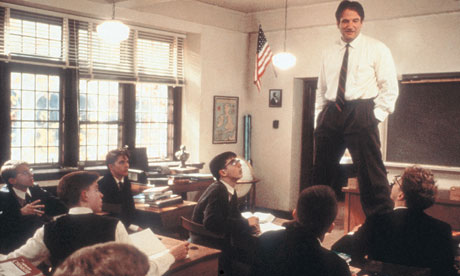
Perhaps one of the biggest contributors to my feelings of psychic entropy is my own unrealistic perception of what successful teaching looks like. Until recently I think that deep down I thought I could be that teacher who jumps on the desk and yells Carpe Diem! and captures the imagination of my young and eager students on a daily - no hourly - basis. In short, until this point it is likely I have been under the influence of educational pornography.


In a short and illuminating post by +Bryce Bunting the idea of educational pornography is explained more fully. Films like Stand and Deliver, or Freedom Writers often captivate and inspire audiences, but don't necessarily paint a realistic idea of what teachers can and should be doing in the classroom.
The reality is that very few teachers have the time, energy, or disposition to approach teaching in the super-human way that is subtly advocated for in these kinds of films. And, when teachers are made to feel that they should all be like Ron Clark (one of the new breed of "inspiring," "innovative," and superstar educators), frustration, hopelessness, and feelings of failure won't be far behind.
Don't get me wrong, the Ron Clarks of the world aren't imaginary. They are real and they are wonderful. However, it is clear that living a balanced and healthy life while maintaining this super teacher lifestyle is simply not sustainable for me or most people in general. 

So I will continue on my way, doing my best. What more can I do, then give my all within the boundaries my mental, physical, and spiritual health will allow? I hope to overcome my sense of psychic entropy and begin making some steps forward. 

"So much in life depends on our attitude. The way we choose to see things and respond to others makes all the difference. To do the best we can and then to choose to be happy about our circumstances, whatever they may be, can bring peace and contentment." 


Monday, May 13, 2013

Native American Cinema - An Interview With Colten Ashley


Colten Ashley: The Anonymous Director
Photo Credit Eric Pasternak
Recently, I sat down with my friend and fellow BYU film student Colten Ashley and asked him about some things concerning Native Americans and film. He has done quite a bit of thinking, writing, and producing on the subject. He is heading up a really neat project you must check out on Kickstarter. And you can also learn more about Colten at his YouTube channel.

With that said - enjoy the show!


Below are some supplemental clips that are related to the audio recording above.


Wednesday, April 10, 2013

Bringing Praxis & Theory Together

Photo courtesy of Flickr Commons
 Even though I will be graduating from film school this month, and have studied great films and filmmakers for the last few years, I often forget that in many ways what I am studying is basically a different medium than what I am creating. I have never shot anything on film (only digital) and never had to cut film together (Final Cut Pro and Adobe Premiere do it all for me). And yet what I am studying greatly impacts what I create.

When studying the greats I am always amazed at the insightful and critical points of view they had. However, it is clear that in most cases there is a strong divide between those with great technical skill -the practitioners, and those with critical abilities -scholars and critics. These two categories are very common in many fields, and it makes sense. I mean, do you think these innovative filmmakers had the time and ability to make those amazing tripod legs and write a critical essay on their work?

It is a long established idea that theory and praxis are two different and separate things. However, at a k-12 level these two approaches to knowledge are often brought together in other subjects. For example, 8th graders might study the different formulas, theories, etc in physics and then work on building a project or simple machine invention that integrates this theoretical knowledge. From Kindergarten on up students are taught not only how to read and critically engage with text, but also how to write in a variety of genres including essay, poetry, persuasive, and research writing.

So, what about media arts? (that is the technical name of my major by the way). Students are exposed to immense amounts of media every day outside of school, and though some get the opportunity to learn how to critically engage with it, few are trained/taught in how to create it. "Yes, but we aren't raising a whole new generation of Spielbergs!" The critic might say. It is true, but just as we recognize the incredible value writing brings to a young person (we aren't raising a generation of Twain's either), it is time we fully acknowledge the importance of learning practical skills of film/media making for the next generation of students.

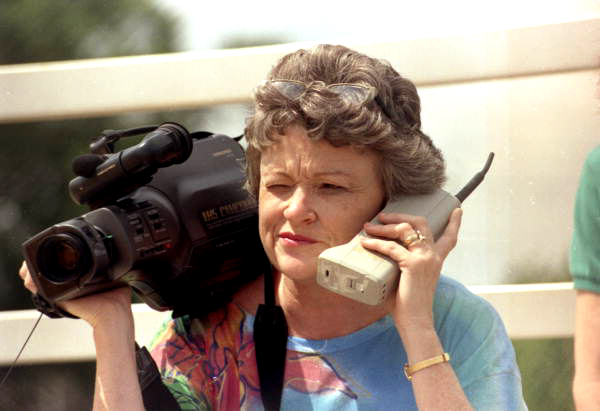
Check out that phone! Photo Courtesy of Flickr Commons
The relatively short history of film making is filled with technological advancements. It used to be that to learn how to create media such as news reports, audio presentations, or films one had to go through lots of training and it took quite a long time (including muscle strength - see photo). I am not suggesting that to learn how to do these kinds of things is now simple. Certainly to do these things well is as or more challenging as it used to be.

However, technology has brought us to the point that students can and should learn both how to read media and how to make it. Schools don't need to invest in expensive cameras or do anything crazy in order to enable this to happen.

The devices that are inundating our world are inevitably overwhelming, helping, scaring, supporting, and changing the way we operate as families, schools, and a society in general. Rather than leave it to kids to deal with or figure out, we should begin teaching them how to create and craft meaningful media. We can and must also help them learn to critically engage and consume media.

Just like English class where students learn to write their own arguments and creative narratives, as well as read, we should support students creating their own media as well as critically reading media texts. It is pretty clear where I stand in response to one of the great debates in Hobbs' 1998 foundational article.

Should media production be an essential feature of media literacy education? Some educators believe that young people cannot become truly critical consumers of the mass media until they have had experience making photographs, planning and organizing ideas through storyboards, writing scripts and performing in front of a camera, designing their own web pages, or reporting a news story.
Renee Hobbs, University of Rhode Island

This semester I participated in BYU's Hands On A Camera Project where a few BYU film students worked with High Schoolers as they created their own documentaries. Not everything went peachy in this experience but I did learned that praxis and theory can and should come together in k-12 classrooms. However, I also learned that doing so is extremely challenging. Issues such as motivation, equipment management, and time, and many other things (I need to write about) all contributed to my questioning of how critical media literacy might be more than just theoretical ponderings.

What do you think? Is there a place for production in our k-12 schools? (Another of Hobbs' debates) What benefits or challenges to you see regarding bringing praxis and theory together?

Thursday, April 4, 2013

How the West Was . . . Won?

Have you seen this film? If not, at least enjoy the epic trailer for it!


The first time I saw this film was in middle school. I remember thinking it was alright, but it was a little too long and there weren't as many battle scenes and stuff as a middle school kid would hope for. Our teacher mentioned that the girls showed too much cleavage sometimes, but that was about the extent of our discussion for the whole film (at least in my memory, which can't always be trusted). 

Couldn't we have discussed so much more? This trailer is dripping with subtleties (some of which aren't so subtle) that need to be called out, subjects that need to be addressed, and lessons that could be taught, all about the massive removal of whole nations of people. But we talked about cleavage.

What about films that are rarely shown in educational settings? Peter Pan was a favorite of mine when I was little, and I really enjoyed the ride at Disney Land. But watching this clip I am shocked with the treatment of Native American's by the filmmakers.


I don't know about you, but watching this makes me feel pretty sick - especially imagining what it might feel like to watch this sitting next to a member of a Native American tribe.

Many kids see films or scenes like this before they have even learned about the slaughtering of native peoples by Europeans and new settlers. Shouldn't we take a little more responsibility by at teaching young people to actively engage with and be critical of the "entertainment" set before them? I wonder if most kids are like I was and figure "Indians are a thing of the past". 


I love this film (Hidalgo, 2004), because it seems to be much more sympathetic to reality when it comes to Native Americans (but maybe not as much with Arabs). Like films such as Dances with wolves it tries to be more accurate, and to me it does so quite convincingly. Other films like Shanghai Noon and Maverick dabble in multiracial conversations that warrant a closer look, especially in their use of humor which is an innovative and interesting way to talk about race and media's portrayal of displaced peoples.


Disney's The Lone Ranger is the next large scaled Hollywood presentation featuring Native Americans. I first heard about it at a lunch in with the Utah Film Commission, and everyone was really stoked because it is being filmed in Utah (at least partially). Some are skeptical about Johnny Depp's role as Tonto and others acknowledge the strange decision to prolong racial profiling from the 30's. Either way, I think it is important to be aware of how Native Americans are portrayed in the media, by Disney or anybody. Does this mean I won't see the film? No, but it does mean I will be critically engaging with it.

As a member of the Church of Jesus Christ of Latter-day Saints I know I am not too happy when my church is inappropriately portrayed in popular culture. I can only imagine what it might be like for a member of a Native American Tribe to watch some of the things Hollywood continues to put out. 

What do you think? Am I being extreme? How has the media influenced your thinking about people or groups different than your own?


Thursday, January 24, 2013

Teaching "Reflexive History"

Daniel Day-Lewis in "Lincoln" (2012)

History has always been one of my favorite subjects because of the stories, the people, and just the diversity that it offers. This NY Times article illustrates a large amount of nuance, history, and discussion material that many of us may completely miss if all we are interested in is the exciting plot (which isn't the biggest sin in in the world). History classes often use movies, some for better and others for worse. Sure, some teachers may just turn on Glory and call it good, but anyone who knows anything about history and teaching knows that is not enough.

What is the point of learning history? Well, obviously "those who don't learn history are doomed to repeat it" and all that, but really - why? I think one of the most important reasons to study history is to better understand ourselves and our times. We need to be reflexive.

When looking at a film there are at least 2 major parts of history being illustrated that encourage reflexive critical thinking.

Russell Crowe in "Robin Hood" (2010)
1. The moment the film was actually made. For example Hotel Rwanda was not made in the '90s. So why does that matter? Well, it might matter more than students can think? Is there anything the film makers could be trying to say by producing the film at the time they did? What were the political and global issues of the time the film was produced? Can anything be learned about the period of time of the film's creation based on the film itself?

Errol Flynn in "The Adventures of Robin Hood" (1938)

2. The time period being represented in the movie.  Robin Hood is one of the most well-known, and yet mysterious figures of our past. But beyond the general bio sketch we have of him, there is a wealth of history available when just looking at how he has been portrayed over the years. Robin Hood with Russell Crowe starring as the hero who is returned from the bloody failed crusades, is a much different rendition than Errol Flynn's portrayal in the early days of Hollywood. Much can be taught about what the life may have been like in the middle ages, and how our perspective has shifted.


I remember my 8th grade history teacher ripping on movies for not being very accurate, and yet he showed Pocahontas and How the West Was Won. What do you think I remember from his class? Well, it is obvious, I can tell you what movies we saw but I can't even remember if we used a textbook for that class. We should be taking advantage of media in the classroom by encouraging critical engagement, not apologizing for it! Students will begin to see how history is relevant and interesting to their own lives as the learn to think critically and be self-reflexive with their media choices.

"Pocahontas" (1995)

For more ideas (and evidence that what I am arguing above is not just the lame thoughts of a college kid) check out Teachwithmovies.com and list of the best 28 history movies to use in the classroom.