Showing posts with label k12. Show all posts

Saturday, August 3, 2013

My Existential Moment and Why Teachers "Making It Relevant" in the Classroom Bothers a Cognitive Scientist

Recently I made the discovery that lead me to believe I was completely off track when it comes to how I view education.


Daniel Willingham, a cognitive scientist at the University of Virginia, came to BYU campus when I was finishing up my final semester there this spring. He shared some really interesting and refreshing concepts related to the brain and how people learn.

To give you an example of some of the kinds of things he shared check out this interesting and important concept from his book Why Students Don't Like School: 
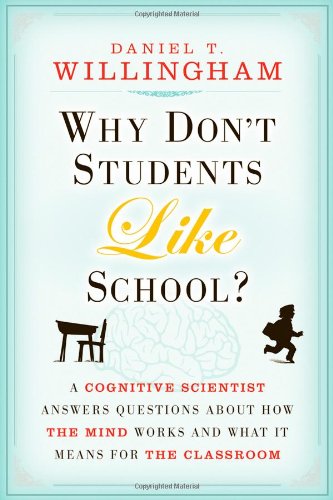
It is a good book.
Researchers have examined student opinion surveys of their college professors to find out which professors get good ratings and why. A two-item survey would be almost as useful as the thirty-item survey, because all of the questions really boil down to two: Does the professor seem like a nice person, and is the class well organized?" (p. 50)
Although K-12 students don't complete questionnaires about their teachers, we know that more or less the same thing is true for them. The emotional bond between students and teachers --for better or for worse -- accounts for whether students learn. The brilliantly well-organized teacher whom fourth graders see as mean will not be very effective. But the funny teacher, or the gentle storytelling teacher, whose lessons are poorly organized won't be much good either." (p. 50-51) 

So what do I mean when I say I may be on the wrong track? Well, what is the name of this blog? The Relevant Classroom. Yup. And I talk all about how relevance is so important and we need to turn to popular culture media more often because that is what kids are consuming so we must help them connect their entertainment to the real world. My somewhat idealistic agenda sounds nice, but the problem is it may not only be ineffective--my goal to make everything being taught in the classroom relevant to students could very well be destructive to student learning.

Huh?

Professor Willingham writes (and I sort of trust him since he does the research and cites it all very clearly): "Trying to make the material relevant to students' interests doesn't work." He goes on to say:
Content is seldom the decisive factor in whether or not our interests is maintained . . . so if content won't do it, how about style? Students often refer to good teachers as those who "make stuff interesting." It's not that the teacher relates the material to students' interests - rather, the teacher has a way of interacting with students that they find engaging. (p. 49-50)
As I read this I experienced a mini rocket ride through the stages of grief. What?! Making material relevant to students' interests doesn't work? How can that be? This guy is nuts. Oh, and yes it turns out he doesn't believe there is such thing really as learning styles, or at least they aren't worth bothering about. I went to my wife and explained that I might have to trash my blog, or at least the title of it, and that basically my whole passion is ruined.

Professor Willingham is a Cognitive
Scientist at the University of Virigina -
and he is a pretty great thinker
But, I decided to keep reading. And came across this more thorough description of Willingham's insights on relevance in education.
"I've always been bothered by the advice 'make it relevant to the students,' for two reasons. First, it often feels to me that it doesn't apply. Is the Epic of Gilgamesh relevant to students in a way that they can understand right now? Is trigonometry? Making these topics relevant to students' lives will be a strain, and students will probably think it's phony. Second, if I can't convince students that some material is relevant, does that mean I shouldn't teach it? If I'm continually trying to build bridges between student's daily lives and their school subjects, the students may get the message that school is always about them, whereas I think  there is value, interest, and beauty in learning about things that don't have much to do with me. I'm not saying it never makes sense to talk about things students are interested in. What I'm suggesting is that student interests shouldn't not be the main driving force of lesson planning. Rather, they might be used as initial points of contact that help students understand the main ideas you want them to consider, rather than as the reason or motivation for them to consider these ideas." (p. 65)
As I read this I thought, "Yes! Exactly." Relevance does have a place, but it is a strategic and limited one. I still think Daniel Pink is right when he says relevance is the 4th R after "reading, writing, and arithmetic," but Willingham's point is valid. If I spend the majority of my time trying to help students see the connection of the Pythagorean theorem or the genus and species of a particular animal in the Mongol desert to their own life rather than on growing their brains and becoming world citizens then what will they remember?
Memory is the residue of thought. To teach well, you should pay careful attention to what an assignment will actually make students think about (not what you hope they will think about), because that is what they will remember. (p. 41)
It turns out that what students spend time thinking about is what they remember. Thus when wielding the tools of relevance, one must consider carefully whether doing so will help students focus more on the skill and objective of the lesson, or simply act as a memory distractor in the future progress of the student. Lesson learned.

So an example of how this concept might play out could be something like the following. Say we are talking about the Civil War in 5th grade. I think to myself, "Oh I want to use popular culture to help the students see the relevance of the war's impact on their lives. I think I will show a clip of Glory with a follow up clip of Gone With The Wind and later a clip of The Help to illustrate the details of the war and the continued impact of segregation and racism in America." Potentially this could be pretty interesting (in my opinion), but there is a huge danger of the students walking away from that only remember that they watched some movie clips and that it was cool to not have to do any work.

Yes, pop culture and media can and should be used. No, it should not cause students to spend time thinking about something outside of the objective set forth in the lesson.

See Professor Willingham's blog or check out his book for more interesting and helpful research that is easy to read and apply.

Monday, May 6, 2013

Testing and the Complexities of Education

Photo by timlewisnm via Flickr
 Last week I was fortunate enough to attend the American Educational Research Association (AERA) conference in San Francisco.  There I presented a paper related to creative Problem-based Learning, ate some amazing food, walked peacefully in the Redwood Forest, and watched with mixed feelings as protestors and scholars alike voiced their thoughts about the complex and sometimes controversial issues of our contemporary education system. I heard some fascinating paper presentations on representations of charter schools in the media, the image and reality of Tinker Bell across the decades, as well as the importance of social justice and needed attention to students who are stuck in perpetual cycles of poverty. What took the cake, though, was my experience watching United States Secretary of Education Arne Duncan address the packed ballroom of the Hilton Hotel in downtown. Here is a little video of what it looked like, thanks to my new and somewhat nifty iTouch.


Not only was it packed, but apparently before I arrived in the line (in which I felt like I was in a huge line for a ride at Disney Land or something) there were some protests organized in preparation for Secretary Duncan. Indeed, as I entered the ballroom I received this paper which, as you can see, some folks felt they should raise often throughout the Secretary's speech.


Can you see them holding the signs? There were moments I thought
there might be a hangin' . . . or a public stoning at least.

The Secretary spoke about the importance of testing, but how the current way of doing things is not working. He talked about improving tests rather than abolishing them, and actually mentioned Paul Tough's book (which I reviewed last week) as an indicator that character education is also an important part of what we should be interested. While I don't doubt the integrity of Secretary Duncan's intentions, I am wary of his agenda of testing on the national level with such intensity and focus. I grew up in a time where these kinds of tests were limited, and I will be forever grateful.

Three professors were allowed to ask the Secretary some questions after his speech, and they did so in a pointed, loaded, and--in some regards--disrespectful in tone and nature. However, I can understand to some degree the argument of these individuals and others who want to see this old failed system out of the way. Currently I am reading Teach Like Your Hair's On Fire, by Rafe Esquith, and his insights on testing resonate with me: maybe because he takes a moderate course between where Secretary Duncan stands and where his opponents seem to be.
"Standardized testing has become a nightmare in our schools. Teachers have become so overwhelmed by testing demands that they no longer have enough time to teach their students the subject they are supposed to master . . . I am not opposed to tests. We need to assess how the kids are doing. Accurate, fair, and reasonable examinations can help parents, teachers, and students see what skills are being mastered and what ares need strengthening. Having accurate data is a gift to all parties concerned. But the current system of testing is broken" (p. 73-74). 
I don't have the experience, the context, or the wits to express or argue a coherent perspective on this issue, but Rafe's words seem pretty good to me. The problem is, just like most big and important issues, we can't solve it in one quick swoop of the hand! We all want change, but we just can't seem to agree how, why, and when we need it.

One thing I do know is that booing, blasting Snoop Dog songs on your iPhone, or cat-calling at the Secretary of Education during his speech at a conference is not only unprofessional (especially for an academic conference), but clearly an immature and foolish way to model appropriate methods of protest. It wasn't hard for me to see which party left the conference seeming more the fool and uncontrollable miscreant with major issues. While I disagree with some of the tones and directions of Secretary Duncan, he took the higher road in San Francisco and I hope I will always do the same when engaging in passionate and important discussions about the future of education and our children.


Thursday, May 2, 2013

How Children Succeed: Book Review

How Children Succeed: Grit, Curiosity, and the Hidden Power of CharacterHow Children Succeed: Grit, Curiosity, and the Hidden Power of Character by Paul Tough
My rating: 5 of 5 stars

This book caught my attention after hearing an interview with Tough of This American Life and NPR Weekends. His work with Heckman and other scholars he references such as Dweck echos many similar trendy philosophies of today's educational literature such as the almost legendary study of the cupcakes and the important concepts of character education.

I thought Tough did a great job at sharing a variety of sources and perspectives on large and complex issues today's children face while in both poverty and educational settings. I really connected with what he shared concerning stress and the high impact that has on a child, particularly one who has little nurturing or comforting figure in the first few years of life. Also the idea of learning how to fail and come away with renewed zeal to succeed is so important.

If you only have an hour or so, look up his interviews on NPR and TAL or just read the final chapter in the book. However, this topic deserves much more of all of our time, and with that in mind I encourage you to read this whole thing and share it with your friends.

View all my reviews

Wednesday, April 10, 2013

Bringing Praxis & Theory Together

Photo courtesy of Flickr Commons
 Even though I will be graduating from film school this month, and have studied great films and filmmakers for the last few years, I often forget that in many ways what I am studying is basically a different medium than what I am creating. I have never shot anything on film (only digital) and never had to cut film together (Final Cut Pro and Adobe Premiere do it all for me). And yet what I am studying greatly impacts what I create.

When studying the greats I am always amazed at the insightful and critical points of view they had. However, it is clear that in most cases there is a strong divide between those with great technical skill -the practitioners, and those with critical abilities -scholars and critics. These two categories are very common in many fields, and it makes sense. I mean, do you think these innovative filmmakers had the time and ability to make those amazing tripod legs and write a critical essay on their work?

It is a long established idea that theory and praxis are two different and separate things. However, at a k-12 level these two approaches to knowledge are often brought together in other subjects. For example, 8th graders might study the different formulas, theories, etc in physics and then work on building a project or simple machine invention that integrates this theoretical knowledge. From Kindergarten on up students are taught not only how to read and critically engage with text, but also how to write in a variety of genres including essay, poetry, persuasive, and research writing.

So, what about media arts? (that is the technical name of my major by the way). Students are exposed to immense amounts of media every day outside of school, and though some get the opportunity to learn how to critically engage with it, few are trained/taught in how to create it. "Yes, but we aren't raising a whole new generation of Spielbergs!" The critic might say. It is true, but just as we recognize the incredible value writing brings to a young person (we aren't raising a generation of Twain's either), it is time we fully acknowledge the importance of learning practical skills of film/media making for the next generation of students.

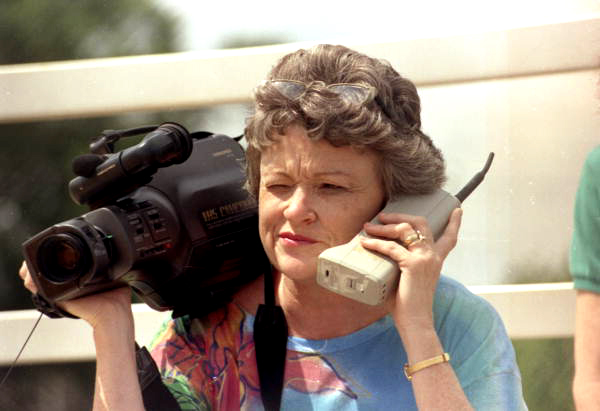
Check out that phone! Photo Courtesy of Flickr Commons
The relatively short history of film making is filled with technological advancements. It used to be that to learn how to create media such as news reports, audio presentations, or films one had to go through lots of training and it took quite a long time (including muscle strength - see photo). I am not suggesting that to learn how to do these kinds of things is now simple. Certainly to do these things well is as or more challenging as it used to be.

However, technology has brought us to the point that students can and should learn both how to read media and how to make it. Schools don't need to invest in expensive cameras or do anything crazy in order to enable this to happen.

The devices that are inundating our world are inevitably overwhelming, helping, scaring, supporting, and changing the way we operate as families, schools, and a society in general. Rather than leave it to kids to deal with or figure out, we should begin teaching them how to create and craft meaningful media. We can and must also help them learn to critically engage and consume media.

Just like English class where students learn to write their own arguments and creative narratives, as well as read, we should support students creating their own media as well as critically reading media texts. It is pretty clear where I stand in response to one of the great debates in Hobbs' 1998 foundational article.

Should media production be an essential feature of media literacy education? Some educators believe that young people cannot become truly critical consumers of the mass media until they have had experience making photographs, planning and organizing ideas through storyboards, writing scripts and performing in front of a camera, designing their own web pages, or reporting a news story.
Renee Hobbs, University of Rhode Island

This semester I participated in BYU's Hands On A Camera Project where a few BYU film students worked with High Schoolers as they created their own documentaries. Not everything went peachy in this experience but I did learned that praxis and theory can and should come together in k-12 classrooms. However, I also learned that doing so is extremely challenging. Issues such as motivation, equipment management, and time, and many other things (I need to write about) all contributed to my questioning of how critical media literacy might be more than just theoretical ponderings.

What do you think? Is there a place for production in our k-12 schools? (Another of Hobbs' debates) What benefits or challenges to you see regarding bringing praxis and theory together?