Showing posts with label media literacy. Show all posts

Thursday, January 2, 2014

Christmas Break Book Reviews

Steve JobsSteve Jobs by Walter Isaacson
My rating: 5 of 5 stars

This book really opened my eyes to the impact of one man on the way I live today. The guy was insane, but the quirks and portrayal Isaacson presents Jobs with makes me want to like him, and now cheer for his products. I have always secretly wondered why I felt a closer affinity with Apple over Windows - even when making defensive statements to my wife as she mocked my MacBook for one reason or another. Now I better understand. Jobs' minimalist and emphatic love of design shaped his world and his passion for perfection. His end-to-end business model combined with his drive for the rebellious image make for a fascinatingly ironic combination that I find very compelling.

If you don't like Apple, or Steve Jobs, or Pixar movies, or digital music, or a host of other things that change the way we currently live - that is fine. But you really should read this book to better understand why things are the way they are!


Present Shock: When Everything Happens NowPresent Shock: When Everything Happens Now by Douglas Rushkoff
My rating: 4 of 5 stars

Though it was a bit difficult to get through, this book is an important read for anyone interested in the evolution of our current digital culture we now live and interact in. I thoroughly enjoyed Rushkoff's insights on time, human interaction, contact, and context. I could be wrong, but I felt that in reading this I was getting a really good introduction to current themes of media theory and digital culture conversation.

Rushkoff basically says we are living in a state of unrest, confusion, and downright chaos due to the fact that we can no longer make sense of our identities and world through linear models. This postmodernist frame of mind he calls "present shock", a state in which we are continually seeking after the elusive present due to our conception of time, trade, entertainment, connection, and purpose. Though he did offer lots of gloom, and at times felt somewhat like he was on a rant, I felt that the book was a little more even-balanced than some.

Even if you don't buy his argument, or feel a sense of solemnity, there is so much packed into Rushkoff's pages that deserve your time. His writing is almost poetical and I feel like I could have spent much longer than the time I did in order to process and think through the different sections of the text. Some books you can skim or read the spark notes on, but really you should just take the time to read this one.

View all my reviews

Thursday, May 30, 2013

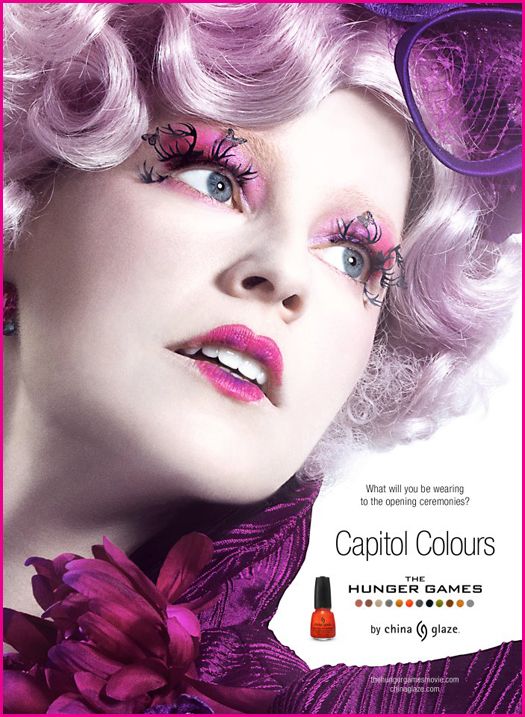
You Too Can Look Like Effie Trinket

Do you want to look like the mindless, frivolous, oppressive upper class of the fictional franchise The Hunger Games? Good news for you, Covergirl has recently announced their plans to enable young girls to look the part! If you have read the books or even seen the movie you should understand to a certain degree the deep irony of this. Imagine a new makeup kit fashioned after Romulans or how about a Nazi package? Yikes - and I am not even talking about Halloween costumes.

It isn't just live action films directed towards teenagers like The Hunger Games or Twilight that use marketing strategies that make me uneasy, but Disney also knows the leverage that comes to their sales department by helping young children identify with glitzy glamour and begin a lifetime of brand loyalty.

There is something wrong with marketing to children. Even more than just marketing, it is unethical to shape the values and self image of young people and can cause serious harm. Unfortunately the classroom is not exempt from all this.

Canada's Centre for Digital and Media Literacy stated in one report: "School used to be a place where children were protected from the advertising and consumer messages that permeated their world—but not any more . . . A school setting delivers a captive youth audience and implies the endorsement of teachers and the educational system." I don't think this applies to all Canadian and American schools, but examples such as supplying schools with technology in exchange for high company visibility and companies sponsoring school events does happen, and I think it is wrong.

What can a teacher do then, if their school or local corporations condone such targeting of kids?

The answer applies regardless of school environment. Due to the enormous impact of the Internet and mind-blowing rates of time children are exposed to media on a daily basis, we can't hide all the garbage from our children. However, we can teach our children how to critically consume the information that inundates their world. Said middle school teacher Caitlin Barry:

"We encourage them (students) to use Google Images and search YouTube to find compelling videos, but we haven't given them any tools to analyze all this media. In many cases, students have no idea how to be critical about what they consume.

Barry goes on to reference the foundational questions of media literacy (listed below): key elements we can push and discuss both in our classrooms and at home.

Who created this message? What creative techniques are used to attract my attention? How might different people understand this message differently? What values, lifestyles, and points of view are represented in, or omitted from, this message? Why is this message being sent?

After pondering the new Hunger Games makeup kit from Covergirl, imagine what a great educational opportunity a teacher or parent could have by running through these questions! 

We should also expand this process to teaching kids to be more critical about food consumption. In her TED talk, Anne Lappe explains important and frightening research about the food industry marketing to you children. Apparently, food marketers spend about 2 billion dollars per year just on marketing to minors. The little video below shares some of the same sentiment as Lappe's talk, including some dramatic music.


There are many things good people are trying to do to stop bizarre marketing schemes like the ones I have mentioned, but something every responsible adult can begin today is to learn and teach the basic questions of media literacy. We need our children to become thoughtful, responsible, and conscious adults - and that possibility looks quite bleak if the waves of marketing and information are consumed without thought or challenge.

Monday, May 13, 2013

Native American Cinema - An Interview With Colten Ashley


Colten Ashley: The Anonymous Director
Photo Credit Eric Pasternak
Recently, I sat down with my friend and fellow BYU film student Colten Ashley and asked him about some things concerning Native Americans and film. He has done quite a bit of thinking, writing, and producing on the subject. He is heading up a really neat project you must check out on Kickstarter. And you can also learn more about Colten at his YouTube channel.

With that said - enjoy the show!


Below are some supplemental clips that are related to the audio recording above.


Wednesday, April 10, 2013

Bringing Praxis & Theory Together

Photo courtesy of Flickr Commons
 Even though I will be graduating from film school this month, and have studied great films and filmmakers for the last few years, I often forget that in many ways what I am studying is basically a different medium than what I am creating. I have never shot anything on film (only digital) and never had to cut film together (Final Cut Pro and Adobe Premiere do it all for me). And yet what I am studying greatly impacts what I create.

When studying the greats I am always amazed at the insightful and critical points of view they had. However, it is clear that in most cases there is a strong divide between those with great technical skill -the practitioners, and those with critical abilities -scholars and critics. These two categories are very common in many fields, and it makes sense. I mean, do you think these innovative filmmakers had the time and ability to make those amazing tripod legs and write a critical essay on their work?

It is a long established idea that theory and praxis are two different and separate things. However, at a k-12 level these two approaches to knowledge are often brought together in other subjects. For example, 8th graders might study the different formulas, theories, etc in physics and then work on building a project or simple machine invention that integrates this theoretical knowledge. From Kindergarten on up students are taught not only how to read and critically engage with text, but also how to write in a variety of genres including essay, poetry, persuasive, and research writing.

So, what about media arts? (that is the technical name of my major by the way). Students are exposed to immense amounts of media every day outside of school, and though some get the opportunity to learn how to critically engage with it, few are trained/taught in how to create it. "Yes, but we aren't raising a whole new generation of Spielbergs!" The critic might say. It is true, but just as we recognize the incredible value writing brings to a young person (we aren't raising a generation of Twain's either), it is time we fully acknowledge the importance of learning practical skills of film/media making for the next generation of students.

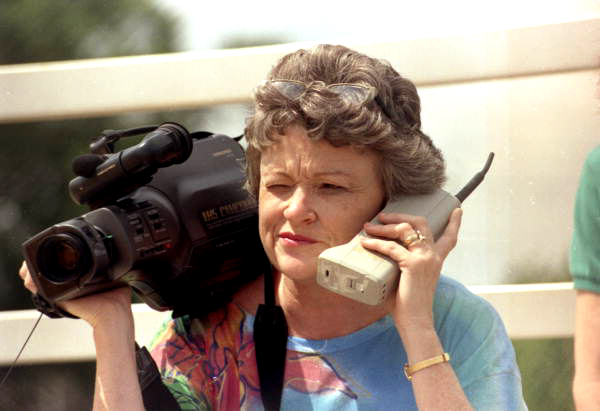
Check out that phone! Photo Courtesy of Flickr Commons
The relatively short history of film making is filled with technological advancements. It used to be that to learn how to create media such as news reports, audio presentations, or films one had to go through lots of training and it took quite a long time (including muscle strength - see photo). I am not suggesting that to learn how to do these kinds of things is now simple. Certainly to do these things well is as or more challenging as it used to be.

However, technology has brought us to the point that students can and should learn both how to read media and how to make it. Schools don't need to invest in expensive cameras or do anything crazy in order to enable this to happen.

The devices that are inundating our world are inevitably overwhelming, helping, scaring, supporting, and changing the way we operate as families, schools, and a society in general. Rather than leave it to kids to deal with or figure out, we should begin teaching them how to create and craft meaningful media. We can and must also help them learn to critically engage and consume media.

Just like English class where students learn to write their own arguments and creative narratives, as well as read, we should support students creating their own media as well as critically reading media texts. It is pretty clear where I stand in response to one of the great debates in Hobbs' 1998 foundational article.

Should media production be an essential feature of media literacy education? Some educators believe that young people cannot become truly critical consumers of the mass media until they have had experience making photographs, planning and organizing ideas through storyboards, writing scripts and performing in front of a camera, designing their own web pages, or reporting a news story.
Renee Hobbs, University of Rhode Island

This semester I participated in BYU's Hands On A Camera Project where a few BYU film students worked with High Schoolers as they created their own documentaries. Not everything went peachy in this experience but I did learned that praxis and theory can and should come together in k-12 classrooms. However, I also learned that doing so is extremely challenging. Issues such as motivation, equipment management, and time, and many other things (I need to write about) all contributed to my questioning of how critical media literacy might be more than just theoretical ponderings.

What do you think? Is there a place for production in our k-12 schools? (Another of Hobbs' debates) What benefits or challenges to you see regarding bringing praxis and theory together?

Thursday, March 28, 2013

Creation, Curation, & Connection

Image source
This post should have been put up a long time ago. I am trying to do better at releasing things early and often rather than refining each post as much as possible. Unfortunately I think the graphic above is a pretty accurate depiction of my behavior online in the last few years. Creating films, presentations, etc. has been a passion of mine, but curation -or gathering and consuming information- has started slowly inhibiting the amount of time I take to do more creative work.


Now what the graphic doesn't show is a third important element that every digitally literate person should be aware of is connection. My English professor, Gideon Burton, made this nifty little tutorial (video above) about these three points, create, consume, and connect, and how they are important to digital literacy. I highly recommend it.

As I reflect on how I am doing with these points of Digital Literacy, I am reminded of the important and often unspoken attribute of balance. Balance seems to be a recurring theme that continues to pop up in my life. I don't think I am alone in this fact though. As the Internet continues to become a more integral part of our everyday living, it is essential that we reflect how we use it. Balance between creating, consuming, and connecting on the Internet - as well as doing all the other important things that don't involve being online- can seem tricky. However, seeking more balance in all these categories we can be more engaged with issues around us.

Indeed becoming digitally literate is an important part of of media literacy. If all we know how to do is critically engage with media, we are greatly limiting ourselves. By learning to create media, consume critically, and connect with other students and people all around the world the media literacy movement will begin to have the meaningful impact on society that it seeks.


Tuesday, March 19, 2013

TeachersClips - the "big idea" is taking shape


What is TeachersClips? Well, this is the thing I have been working on for quite some time. Recently I've had the help of a team of students, and the dream of a database of popular culture clips that can be used in classrooms is starting to become a reality. Up until recently I affectionately referred to it as "my big idea" -which is kind of lame since I am not the one and only person to ever think it up, but now we have a name and second iteration which is almost ready to be released! (see the first iteration here). We have lots of work to do, but I am excited about how things are going.

Our team has gone out and asked for teacher feedback, and we have two great students who are working on the programming of the actual site. We have some pretty good design options in mind (see some shots below) and a few people have committed to beta testing this thing out for us. Last week we pitched the idea to some local experts and actually didn't get very positive comments. I was frustrated (and still am!) because lots of their written feedback appeared to be directly related to things I said. It is likely I wasn't extroverted and clear enough. That is why we need your feedback!

I am flabbergasted by how little I have been blogging about this experience. I will try and correct my ways and get the news out better.
So what if the home page became your profile or hub of clips once you have set up a profile? We have tossed around the idea of having the home page just be the browse page once you have created an account. We want to enable bookmarking so that if and when teachers see clips they want to use for a future unit they can easily bookmark it into separate folders for later use. 


This "Share" page will probably be a pop out form rather than an actual page on the site. Knowing how little time teachers have, we want to make it as easy and quick as possible to share media. Of course, the more info we get on each clip, the more cool stuff we can do with it later - so it is tough to find a balance.

Notice the big empty white space below the last grey bar? We are hoping to have this space filled in with Pinterest-styled thumbnails/images. The Browse page is not meant to fulfill the same purpose as the search feature. This is a place to get new ideas, look around, and bookmark clips away that look interesting. Thus we hope that as more and more people add things to TeachersClips one can just scroll down and look at what is new. Of course if you want to see something specific or search the tags that is what the search feature is for. The top three lines of clips will be constant ("Related to your subject", "New clips", and "Most viewed?). What do you think? Is there a better way? Would you use this site if it was fully functional?

Sunday, March 17, 2013

A Media Literacy Community

#medialiteracy on Twitter, NAMLE, MakingCurriculum Pop, and Facebook seem to be pretty good places to discuss education and many other ideas. However, I know of no Google+ presence revolved around media literacy. I wonder if I can cultivate a small network of teachers, researchers, and interested people oriented around Media Literacy on Google’s social networking platform? I think it would be great to also have homeschooling educators, parents, and even students too!

What is media literacy? 

I love these points below which are posted on the National Association for Media Literacy Education website. While they are helpful to better understanding the field, the definition of media literacy is by no means final or secured. 
  • Media refers to all electronic or digital means and print or artistic visuals used to transmit messages.
  • Literacy is the ability to encode and decode symbols and to synthesize and analyze messages.
  • Media literacy is the ability to encode and decode the symbols transmitted via media and the ability to synthesize, analyze and produce mediated messages.
  • Media education is the study of media, including ‘hands on’ experiences and media production.
  • Media literacy education is the educational field dedicated to teaching the skills associated with media literacy.


I have created the community on G+ and started actively working with it about a week ago. The image above is the icon for the group, and I am hoping to build a network of interested people who have things to say or who are just curious about what is being said. The purpose of a G+ community in my mind is not necessarily about gathering cool content, as it is an opportunity to ask questions, share ideas, and engage with others about important issues. Since I am obviously no expert of media literacy, I don't expect to be teaching or handing information to others in a didactic fashion. Rather I see this group as a chance to expand what I am reading and learning about, especially as I begin teaching grade school this fall. 


I am currently reading Media Literacy Is Elementary by Jaff Share. Near the beginning of the book he states, "We live in a multimedia age where the majority of information people receive comes less often from print sources and more typically from highly constructed visual images, complex sound arrangements, and multiple media formats." We spend a great deal of time teaching youngsters to learn how to spell, write, make arguments in essays, and so forth -but how often do we help them understand or deconstruct advertisements, films, and other forms of pop culture? If this is what they are consuming all the time, shouldn't we try and help them better understand these "highly constructed" media messages? I am all for kids reading, I think that is one of the most important activities they can do. In fact I think reading and becoming acquainted with good literature can help students understand issues of technology and media better than almost anything else. However, in our media drenched world where people are getting information in other ways we need to adjust our teaching to include more forms of media than the written word. 


Media literacy should be a very important part of every student's educational experience, at least to some degree. Please Join me and the Media Literacy Community and share the group with your friends.